Causal Inference with Bayesian Networks by Yousri El Fattah (.ePUB)
File Size: 10.8 MB
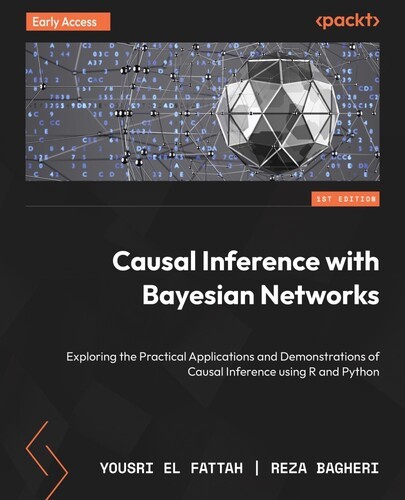
Causal Inference with Bayesian Networks: Exploring the Practical Applications and Demonstrations of Causal Inference using R and Python (Early Access) by Yousri El Fattah, Reza Bagheri
Requirements: .ePUB reader, 10.8 MB
Overview: Leverage the power of graphical models for probabilistic and causal inference to build knowledge-based system applications and to address causal effect queries with observational data for decision aiding and policy making. This is a practical guide that explores the theory and application of Bayesian networks (BN) for probabilistic and causal inference. The book provides step-by-step explanations of graphical models of BN and their structural properties; the causal interpretations of BN and the notion of conditioning by intervention; and the mathematical model of structural equations and the representation in structured causal models (SCM). For probabilistic inference in Bayesian networks, you will learn methods of variable elimination and tree clustering. For causal inference you will learn the computational framework of Pearl’s do-calculus for the identification and estimation of causal effects with causal models. In the context of causal inference with observational data, you will be introduced to the potential outcomes framework and explore various classes of meta-learning algorithms that are used to estimate the conditional average treatment effect in causal inference. The book includes practical exercises using R and Python for you to engage in and solidify your understanding of different approaches to probabilistic and causal inference. By the end of this book, you will be able to build and deploy your own causal inference application. You will learn from causal inference sample use cases for diagnosis, epidemiology, social sciences, economics, and finance. This book will serve as a valuable resource for a wide range of professionals including data scientists, software engineers, policy analysts, decision-makers, information technology professionals involved in developing expert systems or knowledge-based applications that deal with uncertainty, as well as researchers across diverse disciplines seeking insights into causal analysis and estimating treatment effects in randomized studies. The book will enable readers to leverage libraries in R and Python and build software prototypes for their own applications.
Genre: Non-Fiction > Tech & Devices
Free Download links: