Introduction to ARM Assembler by Roger Ferrer Ibáñez (.PDF)+
File Size: 10 MB
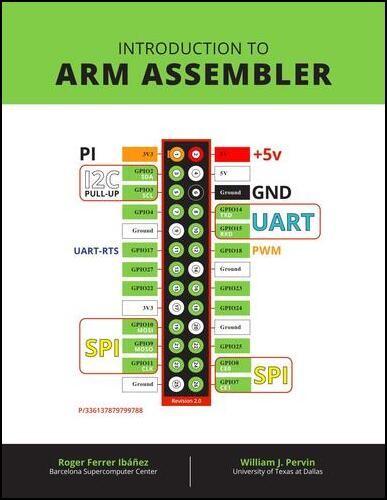
Introduction to ARM Assembler by Roger Ferrer Ibáñez, William J. Pervin
Requirements: .ePUB, .PDF reader, 10 MB | True PDF, EPUB
Overview: “Introduction to ARM Assembler” is a 200-page booklet focused on the use and construction of the computer software tool known as Raspbery Pi. It includes an extensive array of computer tools aimed at interfacing the Raspbery Pi software to a hardware computer. You will see that our explanations do not aim at being very thorough when describing the architecture. We will try to be pragmatic. ARM is a 32-bit architecture that has a simple goal in mind: flexibility. While this is great for integrators (as they have a lot of freedom when designing their hardware), it is not so good for system developers who have to cope with the differences in the ARM hardware. So in this text we will assume that everything is done on a Raspberry Pi 2 Model B running Raspbian (the one with at least 2 USB ports and 512 MB of RAM). Some parts will be ARM-generic but others will be Raspberry Pi specific. We will not make a distinction. An assembler language is just a thin syntactic layer on top of its binary code. Unfortunately, while somewhat similar in concept, they differ greatly between different architectures. Learning one will certainly help in learning others, but it will still require lots of work. So we will write assembler – ARM assembler. Since the computer cannot run assembler code, we have to get binary code from it. We use a tool called, well, an assembler to assemble the assembler code into binary code that we can run. The program to do this is called as and we will use it to assemble our programs. In particular it is the GNU Assembler, which is the program from the GNU project and sometimes it is also known as gas for this reason.
Genre: Non-Fiction > Tech & Devices
Free Download links: