Knowledge Graphs and Semantic Computing 10th China by Jiye Liang(.PDF)
File Size: 67.6 MB
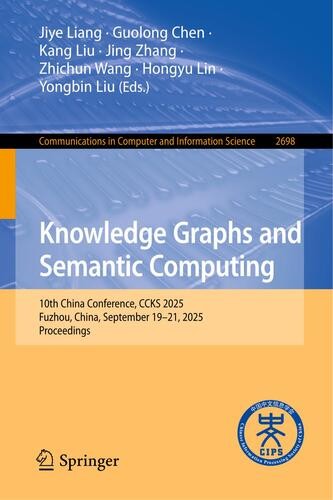
Knowledge Graphs and Semantic Computing 10th China Conference, CCKS 2025, Fuzhou, China, September 19–21, 2025, Proceedings (Communications in Computer and Information Science) by Jiye Liang, Guolong Chen, Kang Liu, Jing Zhang, Zhichun Wang, Hongyu Lin, Yongbin Liu
Requirements: .ePUB, .PDF reader, 67.6 MB | True PDF, True EPUB
Overview: This book constitutes the proceedings of the 10th China Conference on Knowledge Graph and Semantic Computing, CCKS 2025, held in Fuzhou, China, during September 19–21, 2025. The 22 full papers presented in this book were carefully reviewed and selected from 112 submissions. They were organized into the following topical sections: Knowledge Graph Construction and Integration; Large Models Enhanced by Knowledge Graphs; Applications of Knowledge Graphs and Large Models/Agents; Open Resources for Knowledge Graphs and Large Models; and Evaluations. Knowledge Graphs (KGs) furnish reliable and structured information that is vital for several downstream applications, including information retrieval and recommendation system. However, the pervasive incompleteness inherent in KGs frequently constrains the efficacy of these applications. To mitigate this limitation, researchers have introduced the Knowledge Graph Completion (KGC) task, which aims to supplement missing facts within incomplete triples. In recent times, contrastive learning has been incorporated into the domain of KGC, yielding substantial enhancements to the discriminative power of KGC models and establishing new performance benchmarks. Nevertheless, current contrastive methodologies usually face the problems of insufficient generalization ability of sparse relations, poor understanding of importance differences towards heterogeneous relations, as well as information redundancy in single-view comparison. To overcome these challenges, this work proposes a novel cross-subgraph attention fusion and comparison method, consisting of oriented noise injection, cross-subgraph attention fusion and cross-subgraph contrastive loss. Especially, it helps to enhance the neighboring aggregation procedure as well as the comparative loss function in existing models, by fully utilizing beneficial and complementary semantic signals from different views in the given KG. Furthermore, this contribution can be regarded as a flexible and easily adaptable plug-in component, engineered for seamless compatibility with extant contrastive learning based KGC architectures.
Genre: Non-Fiction > Tech & Devices
Free Download links: