Agentic Coding by Kaven Ward (.ePUB)
File Size: 8 MB
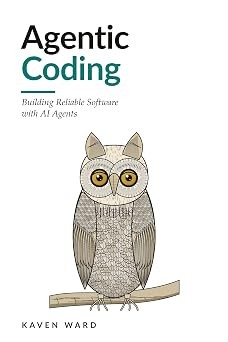
Agentic Coding: Building Reliable Software with AI Agents by Kaven Ward
Requirements: .ePUB reader, 8 mb
Overview: AI can already write, and rewrite, an entire feature while you get coffee. That’s not the hard part anymore. The hard part is knowing whether to trust what it just did — and building the engineering discipline that lets you find out.
Agentic Coding: Building Reliable Software with AI Agents is a systematic guide to that discipline. It isn’t a tutorial for any one tool, and it won’t walk you through a particular CLI’s flags — those change every few months. Instead, it gives you the mental models and engineering mechanisms that stay useful no matter which coding agent you’re driving: how to turn a vague requirement into a task an agent can actually execute and you can actually verify; how to manage a limited context window as your most contested resource; how to decide what an agent may do on its own, what it must escalate, and what it must never touch; and how to keep an entire codebase, a whole team, and a production pipeline governable once agents are doing real work inside them.
The book is built around a simple, recurring worry: agents are eager, confident, and occasionally wrong in ways that look exactly like being right. To make that worry productive rather than paralyzing, the book develops its own working vocabulary — the Four Paradoxes of AI collaborators, Trust Engineering’s four pillars of delegation, safety, accountability, and compliance, and evidentiary thinking as the core habit of mind a developer needs once code itself is no longer scarce. These aren’t abstractions for their own sake; each one comes with the failure mode it’s meant to catch and the concrete mechanism — a Mission Brief, an Autonomy Envelope, a Structured Decision Request, an N-version Exploration — that catches it.
Every mechanism is grounded in IoTFlow, a fictional but fully worked-through IoT platform that runs through all twenty-four chapters. You’ll watch the same gateway module get a feature scaffolded, then break in production, then get refactored, then get migrated — so every technique is shown solving a real problem in a real codebase, not floating free as a slide-deck principle.
The book moves from the fundamentals of what an agent is and isn’t, through the full working loop of intent, context, tools, and verification, into harder terrain: multi-agent pipelines, codebases built to stay legible to humans and agents alike, delivery and governance at production scale, and the open research questions the field hasn’t answered yet. Four appendices — a glossary, a set of engineering templates, a prompt-engineering quick reference, and a full map of the IoTFlow example — turn the book into something you’ll keep open on a second monitor, not just read once.
Genre: Non-Fiction > Tech & Devices
Free Download links: