Principles of Portfolio Choice by Jan Vecer (.ePUB)+
File Size: 12 MB
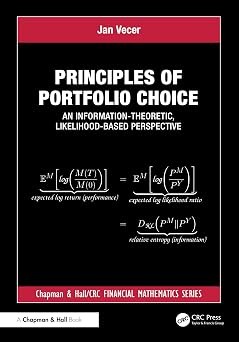
Principles of Portfolio Choice: An Information-Theoretic, Likelihood-Based Perspective by Jan Vecer (Chapman and Hall/CRC Financial Mathematics Series)
Requirements: .PDF/.ePUB reader, 12 mb
Overview: Principles of Portfolio Choice: An Information-Theoretic, Likelihood-Based Perspective develops a scenario-level theory of portfolio selection. Its starting point is simple but powerful: market prices assign values to future scenarios, and once normalized these state prices define a market-implied probability measure. An investor who disagrees with the market is therefore not merely choosing portfolio weights; she is choosing a different likelihood model over the same scenarios.
The book’s central translation is that a budget-normalized nonnegative payoff is a likelihood ratio. It compares the probability measure implied by a portfolio with the probability measure implied by market prices. Thus a portfolio is not only a financial object but also a statistical object: it expresses a scenario distribution. Conversely, a desired scenario distribution determines the payoff that would implement it, whenever that payoff can be replicated.
From this perspective, portfolio choice becomes a form of likelihood-model selection under market constraints. The investor first specifies the scenario probabilities she wishes to express; the financial problem is then to find the attainable payoff whose implied distribution best matches that view.
This scenario-by-scenario viewpoint connects portfolio theory to statistics and information theory. At the Kelly optimum, expected log return becomes relative entropy. Realized wealth becomes a likelihood score. Long-run performance becomes accumulated statistical evidence. Constrained portfolio selection becomes the problem of choosing a desired scenario distribution and finding the closest attainable market payoff.
The book translates Kelly growth, utility maximization, mean–variance analysis, martingale pricing, option payoffs, hedging, Bayesian averaging, and model selection into this likelihood-based language. It shows that many classical methods can be understood as approximations, transformations, or constrained versions of a single payoff-measure dictionary.
Written for quantitative analysts, portfolio managers, researchers, and graduate students, the book offers a new foundation for thinking about prices, beliefs, payoffs, and evidence in financial markets.
Genre: Non-Fiction > General
Free Download links: