AI for the Ordinary by Raghu Vijay Kowshik (.PDF)
File Size: 32.9 MB
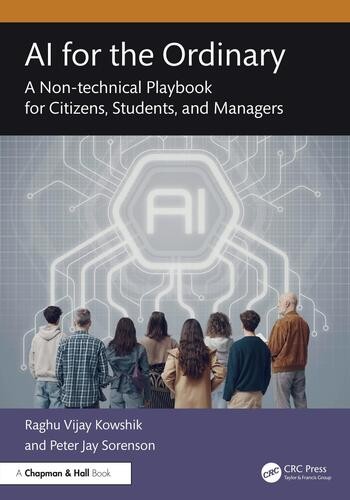
AI for the Ordinary: A Non-technical Playbook for Citizens, Students, and Managers by Raghu Vijay Kowshik, Peter Jay Sorenson
Requirements: .PDF reader, 32.9 MB | True PDF
Overview: AI for the Ordinary is a timely and accessible guide that demystifies Artificial Intelligence (AI) for everyday citizens and non-technical professionals. It makes a compelling case that AI is no longer the exclusive domain of coders and technologists—it is a civic, economic, and personal imperative. From managing household routines to making strategic decisions at work, this book shows how AI literacy is now essential for life and leadership in the 21st century. Written in plain English with no coding or math required, the book bridges the gap between complex technologies and real-world relevance. It explores how AI tools are already embedded in our phones, browsers, and workplaces, and how ordinary users can engage with them safely and effectively. Through global examples, hypothetical case studies, and ethics-aware guidance, readers learn to make informed choices about privacy, bias, and automation. The book also addresses the awareness gap—what users know, what they often miss, and why it matters—empowering people to use AI not just to save time, but to create, learn, connect, and grow. This book refects three related trends in contemporary society: First, Generative AI, powered by models like OpenAI’s GPT-4, Google’s Gemini, DeepSeek, is revolutionizing content creation, coding, and design. Beyond text generation, multimodal AI—GitHub Copilot, Open Image Creator, Mattergren, SPARROW—which processes and integrates multiple data types like text, images, and video—enables more sophisticated applications, such as AI-generated art, voice assistants, and advanced chatbots—for example, AI-powered design tools like Adobe Firefy and ChatGPT’s image capabilities. Second, AI-driven automation is expanding in manufacturing, logistics, and autonomous vehicles. Advances in robotics, computer vision, and reinforcement learning are enabling more innovative industrial automation, autonomous delivery systems, and even AI-powered medical robots. Examples are Tesla’s self-driving technology and Boston Dynamics’ AI-powered robots. Third, as AI adoption grows, concerns around bias, transparency, and data privacy have led to an increased focus on ethical AI practices and regulations. Governments and organizations are implementing AI governance frameworks to ensure responsible AI deployment. Examples include the European Union’s AI Act and initiatives promoting Explainable AI (XAI).
Genre: Non-Fiction > Tech & Devices
Free Download links: