Transforming Life Sciences with Cloud and AI by Zhong Wang (.ePUB)+
File Size: 33.1 MB
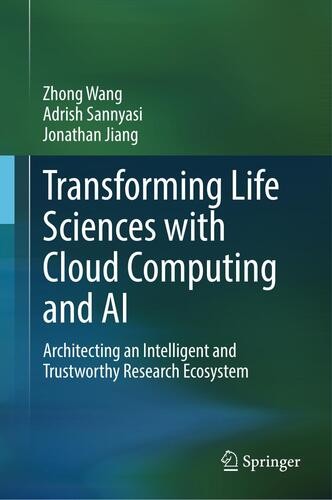
Transforming Life Sciences with Cloud Computing and AI: Architecting an Intelligent and Trustworthy Research Ecosystem by Zhong Wang, Adrish Sannyasi, Jonathan Jiang
Requirements: .ePUB, .PDF reader, 33.1 MB | True PDF, True EPUB
Overview: This book explores the “triple helix” of data, cloud computing, and Artificial Intelligence (AI), exploring how this powerful convergence is reshaping life sciences. It serves as a comprehensive guide to the technologies driving this revolution, from the foundational principles of scalable cloud infrastructure to the architecture of the Generative AI and Large Language Models that are learning to speak the language of biology. The book examines the practical application of these tools across several domains, including pandemic mitigation, the future of personalized health, and the development of a sustainable bioeconomy, offering readers a clear understanding of both the technological underpinnings and their real-world impact. Moving beyond theory, the book provides a pragmatic roadmap for implementation, tackling the significant challenges of R&D productivity, data quality, and operational efficiency. It founds a blueprint for building trustworthy AI by detailing the essential pillars of security, privacy, and compliance. Finally, this work presents a compelling vision for an “Intelligent Discovery Environment for Science,” where human-AI partnerships dissolve the barriers between idea and execution. It is a call to action for researchers, technologists, and leaders to collaboratively build a more efficient, equitable, and human-centric future for science. Deep Learning models are typically defined in high-level interpreted languages like Python. The default “eager execution” mode in frameworks like PyTorch and TensorFlow executes the operations in a model sequentially. While this is flexible for debugging, it also introduces a significant overhead, as each operation requires communication between the Python interpreter and the low-level compute kernels. It also prevents the framework from performing any global optimizations across multiple operations.
Genre: Non-Fiction > Tech & Devices
Free Download links: