Machine Learning With Julia by Jeremiah D. Deng (.PDF)
File Size: 13.3 MB
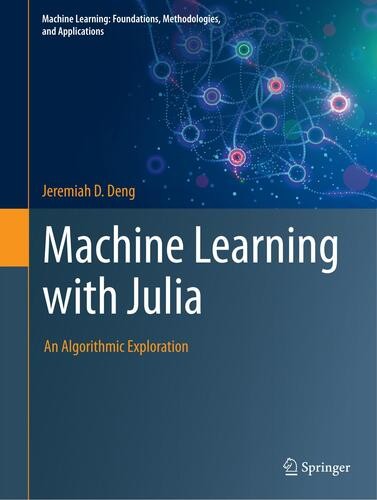
Machine Learning With Julia: An Algorithmic Exploration (Machine Learning: Foundations, Methodologies, and Applications) by Jeremiah D. Deng
Requirements: .PDF reader, 13.3 MB
Overview: This textbook offers a comprehensive and accessible introduction to Machine Learning with the Julia programming language. It bridges mathematical theory and real-world practice, guiding readers through both foundational concepts and advanced algorithms. Covering topics from essential principles like Kullback–Leibler divergence and eigen-analysis to cutting-edge techniques such as deep transfer learning and differential privacy, each chapter delivers clear explanations and detailed algorithmic treatments. Sample code accompanies every major topic, enabling hands-on learning and faster implementation. By leveraging Julia’s powerful Machine Learning ecosystem—including libraries such as Flux.jl, MLJ.jl, and more—this book empowers readers to build robust, state-of-the-art Machine Learning models. Julia, co-created by Jeff Bezanson, Stefan Karpinski, Viral B. Shah, and Alan Edelman around 2009, has become a serious contender for the best programming language and ecosystem for data science and machine learning. Based on a powerful combination of parametric polymorphism with multiple dispatch, just-in-time compiling, direct calling to C and Fortran libraries, and concurrency support, Julia is a dynamic and interactive language as easy to use as Python or R while at the same time achieving highly impressive performance. In Julia, the two-language problem – that we tend to use a high-level (but usually sluggish) language for scripting and prototyping and a low-level (and inconvenient) language for performance – finds a solution. We can use Julia for both purposes. We can write “scripts” for quick experimentation, or venture for low-level but high-performance code, or both. Using “for” loops in Julia is lightning fast, unlike in Python where speed would be compromised whenever vectorization is impossible. The syntax of Julia is quite straightforward and similar to that of MATLAB, and to some extent Python too. Ideal for students, researchers, and professionals alike, this textbook is designed for those seeking a solid theoretical foundation in Machine Learning, along with deep algorithmic insight and practical problem-solving inspiration.
Genre: Non-Fiction > Tech & Devices
Free Download links: