Experimenting with Red Pitaya STEMlab Gen 2 by Dogan Ibrahim (.PDF)
File Size: 14.2 MB
Experimenting with Red Pitaya STEMlab Gen 2: Practical Projects and Programs by Dogan Ibrahim
Requirements: .PDF reader, 14.2 MB | True PDF
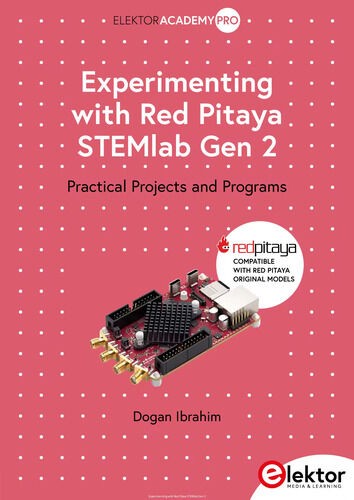
Overview: With Experimenting with Red Pitaya STEMlab Gen 2, Red Pitaya goes beyond a versatile board. It becomes a powerful laboratory instrument for precision measurement, analysis, and control. From the fundamentals of electronic project development, monitoring, control, and design to testing, this book walks you step-by-step through everything you need to know to harness the full potential of Red Pitaya hardware and software. The book presents real-time, FPGA-based projects that are developed on a PC using the Vivado environment, then transferred to the Red Pitaya for execution and testing. You will learn about enhanced performance, expanded I/O capabilities, improved FPGA features, and advanced connectivity options that open up new frontiers for precision measurement, monitoring, and control in your embedded applications. Red Pitaya is a credit card-sized, open-source test and measurement board that can be used to replace most measurement instruments used in electronics laboratories. With a single click the board can be transformed into a web-based oscilloscope, spectrum analyzer, signal generator, LCR meter, Bode plotter, and microcontroller. The Red Pitaya can replace the many pieces of expensive measurement instruments found at professional research organizations and teaching laboratories. Red Pitaya is a network attached device based on Linux. The device includes an FPGA, digital signal processing (DSP), dual core ARM Cortex processor, signal acquisition and generation circuitry, micro USB socket, microSD card slot, RJ45 socket for Ethernet connection, and USB socket. Red Pitaya can be controlled using Matlab, LabView, Python, Scilib, and Visual Programming Language. Even the newcomers to the field of electronics and computing can start writing applications and programs using the visual programming language and they can create basic to intermediate level projects. Red Pitaya offers two analog inputs and two analog outputs, as well as digital I/O ports, making it suitable to interface to the external world of sensors, actuators, and displays. This book is written for educators, researchers, and students seeking both a practical introduction and a detailed technical reference to Red Pitaya in the context of test and measurement. It provides an overview of the hardware and software architecture, explores measurement principles, and demonstrates how the platform can be adapted for various laboratory and research applications. Students can use the Red Pitaya to learn the practical applications of various electronic components, including resistors, capacitors, inductors, diodes, transistors, operational amplifiers, and so on.
Genre: Non-Fiction > Tech & Devices
Free Download links: