Simulation Models for Data Science (ER) by Dan Sullivan (.ePUB)+
File Size: 10 MB
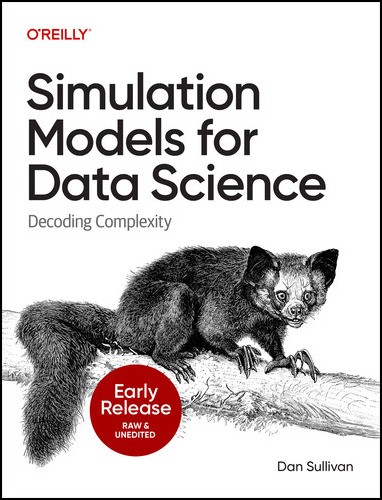
Simulation Models for Data Science: Decoding Complexity (2026-03-25: Early Release) by Dan Sullivan
Requirements: .ePUB, .PDF reader, 10 MB
Overview: Organizations now rely on data and Machine Learning to guide decisions, yet questions about future actions remain. Historical analysis explains what occurred in the past and predictive models estimate outcomes, but neither explores alternative scenarios. Simulation modeling fills this gap, letting analysts ask what if questions, experiment with change, and study how systems behave under different conditions before decisions are implemented. If simulation is so useful, why haven’t data scientists and data analysts employed it more? And why should you be adopting it now? There have been barriers to entry that have limited the adoption of simulation. Traditionally, simulation modeling required an understanding of specialized languages such as Simul8 and AnyLogic or the ability to code simulations in Python or R using specialized libraries. These are not the tools data professionals are used to working with, like SQL and Pandas. In addition, simulation modeling requires an understanding of probability distributions, statistical sampling methods, and queueing theory. Designing, building, and validating simulation could take a long time and can be hard to justify when using traditional simulation tools and software practices. Generative AI and specification-driven development are fundamentally altering the simulation landscape. Large language models and large reasoning models are increasingly proficient at creating simulation code. Specification-driven development practices employ the rapid, exploratory nature of vibe coding but combine it with detailed requirements, technical architecture design, data models, API contracts, and security best practices.
Genre: Non-Fiction > Tech & Devices
Free Download links: