Getting Started with Claude Opus 4.7 by Daniel M. Razo (.ePUB)+
File Size: 10 MB
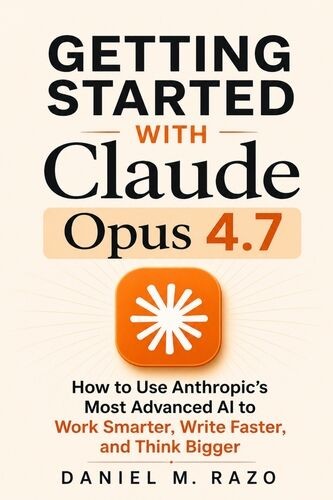
Getting Started with Claude Opus 4.7: How to Use Anthropic’s Most Advanced AI to Work Smarter, Write Faster, and Think Bigger by Daniel M. Razo
Requirements: .ePUB, .PDF, .MOBI/.AZW reader, 10 MB
Overview: Still copying and pasting prompts and hoping for the best? Claude Opus 4.7 is built for something far more serious than that. Most people use AI like a search engine with better grammar. They type something vague, get something generic, and wonder why the results never quite match what they needed. Meanwhile, Opus 4.7 is planning tasks, checking its own work, and running multi-step workflows without being babysat. The gap between how most people use this model and what it actually does is wide open. Getting Started with Claude Opus 4.7 is the practical guide that closes that gap. Written for professionals who want results, not theory, this book covers every major capability of Anthropic’s most advanced publicly available AI model, from writing and research to agentic workflows and team deployment. Whether you are new to Claude or upgrading from an earlier version, this is the Claude AI guide for beginners and experienced users alike who want to work faster without producing mediocre output. This is not a feature tour. Every chapter is built around real tasks: reviewing contracts, prepping for high-stakes meetings, writing first drafts that don’t need to be rebuilt, running code reviews that catch logic errors before production. If you have been looking for an Artificial Intelligence productivity book that treats you like a professional, this is it. Every developer has a mental model of what an AI coding tool is. It sits next to your editor. You ask it questions. It suggests completions. You accept or reject them. The loop is short, the interaction is granular, and you are in control of every line that enters the codebase. Claude Code does not fit that mental model. It is not a suggestion engine. It is an agent that runs in your terminal, reads your entire codebase, writes and edits files across multiple directories, executes shell commands, manages git operations, and keeps working until the task is done or it hits something it cannot resolve without you. The interaction model is not granular. It is delegated. That difference is the entire chapter. Understanding it determines whether you use Claude Code the way it was designed or spend three months using a powerful agentic system as a slightly better autocomplete.
Genre: Non-Fiction > Tech & Devices
Free Download links: