Scientific Machine Learning with Engineering by Timon Rabczuk (.ePUB)+
File Size: 59.9 MB
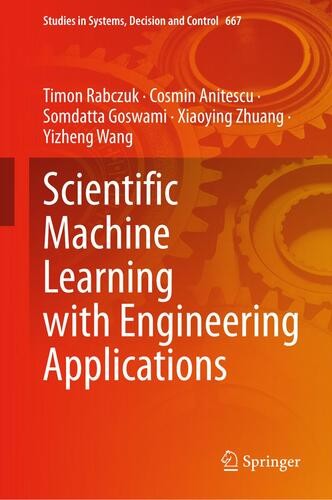
Scientific Machine Learning with Engineering Applications by Timon Rabczuk, Cosmin Anitescu, Somdatta Goswami, Xiaoying Zhuang, Yizheng Wang
Requirements: .ePUB, .PDF reader, 59.9 MB | True PDF, True EPUB
Overview: This book equips readers with a rigorous and practical framework for solving complex engineering problems directly from governing equations using modern Machine Learning techniques. It bridges established principles from mechanics, numerical analysis, and scientific computing with emerging physics-based learning approaches, enabling reliable modeling, simulation, optimization, and inverse analysis beyond purely data-driven methods. A distinctive feature is its critical comparison of Machine Learning-based solvers with classical techniques such as the finite element method, isogeometric analysis, and meshfree methods, highlighting strengths, limitations, and domains of applicability. The scope ranges from foundational concepts to advanced engineering applications, supported by worked examples, reproducible code, and extensive references. Machine Learning (ML) methods, theory and algorithms stemmed from applied mathematics and Computer Science. They have been recognized as efficient tools to tackle complex and urgent problems in health care, smart mobility, environment, human interactions, etc. This key technology is thus becoming part of our day-to-day lives for the benefit of all, and so its application to engineering will improve safety, reliability, efficiency and economical aspects of a wide range of engineering challenges. ML methods have seen a very significant increase in their application to various scientific fields, in particular for cases where patterns can be extracted from complex data sets. Many of the underlying principles, such as the basics of artificial neural networks, have been developed several decades ago in the quest for useful Artificial Intelligence applications. The content is written from an engineering point of view. It explains concepts and formulations and provides details on implementation through Python code examples using modern Machine Learning frameworks. We present classical benchmark problems and interesting numerical examples to demonstrate the capabilities and performance of the methods. The book is intended for graduate students, researchers, and practitioners in engineering, applied mathematics, and computational sciences who seek a principled entry point and a state-of-the-art reference for physics-based Machine Learning in modeling and simulation.
Genre: Non-Fiction > Tech & Devices
Free Download links: