Vibe Engineering (MEAP v5) by Tomasz Lelek (.ePUB)+
File Size: 17.0 MB
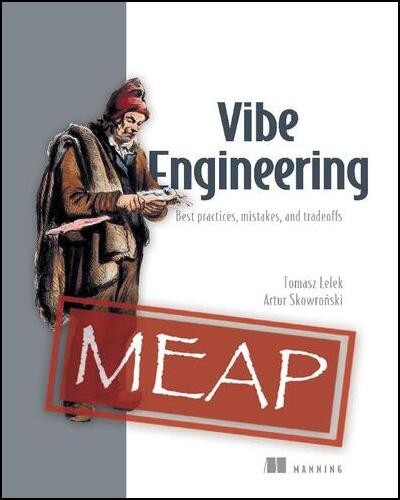
Vibe Engineering: Best practices, mistakes, and tradeoffs (MEAP v5) by Tomasz Lelek, Artur Skowroński
Requirements: .ePUB, .PDF reader, 17.0 MB
Overview: Master vibe engineering—an end-to-end process to navigate the costs, benefits, and tradeoffs of AI-augmented development. Generating code with AI can feel effortless, but it’s only one part of software engineering. A production-grade development pipeline includes testing, validation, refactoring, optimization, and deployment. This book shows you how to go from AI-assisted coding to a AI-infused full-spectrum process author Tomasz Lelek and Artur Skowronski call vibe engineering. If vibe coding is alchemy, chaotic and unreliable, then vibe engineering is applied chemistry – systematic, rule-based, and grounded in measurable evidence. It’s a discipline that combines the creative power of LLM prototyping with the non-negotiable pillars of professional software engineering: rigorous testing, quality assurance, solid error handling, attention to edge cases, fulfillment of non-functional requirements (performance, scalability, security), and production stability. This concept is an evolution – not a rejection – of timeless engineering wisdom. As Martin Fowler once put it: “Any fool can write code that a computer can understand. Good programmers write code that humans can understand.” In the AI era, this statement takes on new weight: we must create not just code, but entire systems that are understandable, verifiable, and safe – even when parts of them are generated by a machine. That’s maybe the biggest irony: AI thrives in the same conditions human developers do – under systems with clear boundaries, crisp contexts, and a reliable chain of verification. This perspective emphasizes that AI is a powerful tool in the hands of the engineer, not a replacement for them. For software engineers, tech leads, and engineering managers. To get the most out of this book, you should have a basic familiarity with Java (and optionally Python) and feel comfortable using a modern IDE such as IntelliJ IDEA or Visual Studio Code. You’ll also need access to ChatGPT (a free account works fine) and, if you’d like to follow along with the examples, Cursor IDE or Visual Studio Code with the Cline extension.
Genre: Non-Fiction > Tech & Devices
Free Download links: