Claude Code: Up and Running (Early Release) by Ken Kousen (.ePUB)+
File Size: 12.6 MB
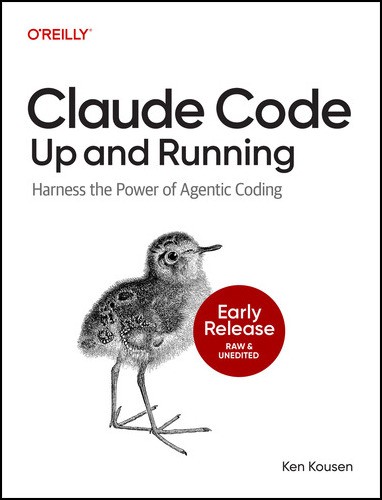
Claude Code: Up and Running: Harness the Power of Agentic Coding (2026-06-18: Early Release) by Ken Kousen
Requirements: .ePUB, .PDF reader, 12.6 MB
Overview: Claude Code is Anthropic’s agentic coding tool for the terminal, designed as an autonomous agent rather than a suggestion engine. It reads files, writes code across multiple files, executes shell commands, works with Git, and connects to external services through the Model Context Protocol (MCP). If you’re comfortable in the terminal, but new to agentic AI tools, this book is your starting point. You’ll learn what the documentation doesn’t cover: where Claude Code looks for CLAUDE.md files, how skill path resolution works, and when headless mode beats an interactive session. In Claude Code: Up and Running, educator and Java Champion Ken Kousen takes you through hands-on examples covering permissions, trust levels, context windows, MCP integrations, model switching, custom slash commands, and multi-agent workflows. A companion GitHub repository with CLAUDE.md templates, hooks, and MCP snippets remains a useful resource long after your first read. This book is for developers who already know how to write software and want to understand what changes when a coding agent can work inside a real project. You do not need to be a Claude Code expert, and you do not need to have used agentic tools before. You should, however, be comfortable reading code, running terminal commands, and thinking about tests, version control, and project structure. The examples move across languages and frameworks: a small JavaScript app, a Python web app, and larger Java and React systems. The point is not to teach those stacks from scratch. The point is to show how the agentic workflow changes as the stakes change. When the language is unfamiliar, that is part of the lesson. Claude Code can act as an embedded tutor, but you still decide whether its explanation is good enough to trust. Senior developers, tech leads, and architects are very much part of the intended audience. Early chapters deliberately start small, because the loop is easiest to see when the project is small. The book does not stay there. The arc runs from a weekend-sized utility to small dependable systems to enterprise-shaped work with permissions, tests, review, integrations, reusable workflows, and CI/CD discipline.
Genre: Non-Fiction > Tech & Devices
Free Download links: