The Craft of Post-Training: AI Engineers by Chris von Csefalvay(.ePUB)
File Size: 19.2 MB
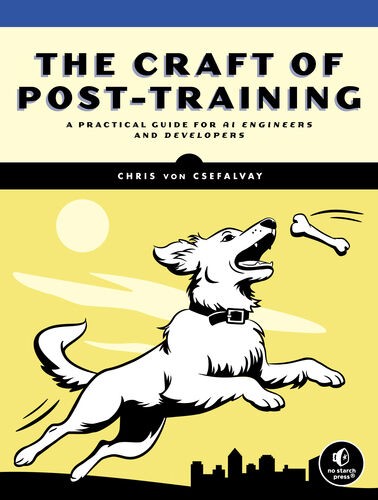
The Craft of Post-Training: A Practical Guide for AI Engineers and Developers by Chris von Csefalvay
Requirements: .ePUB reader, 19.2 MB
Overview: Capable by default. Reliable by design. A pre-trained model has read most of the internet—and can be trusted with almost none of it. Post-training is the work that changes that: where you take a raw, general model and shape it into something that behaves, follows instructions, refuses what it shouldn’t do, and handles the specific job you need. It’s the human hand on the machine, and the part almost no one explains. Chris von Csefalvay has spent his career building production ML systems in industry, from clinical language to legal text. In The Craft of Post-Training, he shows you the decisions behind every technique: when to fine-tune and when not to, why a model quietly gets worse, and which method fits the constraint you’re actually under. The math is here, because knowing why a technique works is what lets you debug it when it breaks. Examples in Python. Code examples, drawn from accompanying Jupyter notebooks, illustrate implementation without drowning the reader in boilerplate. Enough code is included to make techniques concrete but not so much that essential ideas are obscured by engineering detail. The notebooks provide complete, runnable implementations, and the text provides annotated excerpts that highlight key patterns. We use a consistent ecosystem throughout: PyTorch, the Hugging Face ecosystem (TRL, Transformers, datasets), CUDA-based acceleration, Optuna for hyperparameter optimization (HPO), Hydra for experiment management, SkyPilot for deployment, and occasionally vLLM. This is an adequate representation of what most practitioners would encounter at a strong enterprise data science/AI team. Readers should be able to move from reading a technique to implementing it with minimal friction, and the notebooks are designed to serve as templates for adaptation to specific use cases. While the examples are selected to be illustrative rather than exhaustive enterprise-grade implementations, they are not toy examples, and we will not be taking shortcuts. This book is primarily for the practicing ML engineer who gets to implement post-training systems. These readers are comfortable with PyTorch, familiar with gradient descent, and capable of reading a research paper and implementing its core ideas. They have trained models before, even if not LLMs specifically.
Genre: Non-Fiction > Tech & Devices
Free Download links:
https://trbt.cc/3wypyj1abfc2.html
https://rapidgator.net/file/e55814c1fb9c2d7ca8d21b5c18f9b4e1/The_Craft_of_Post-Training.epub.html